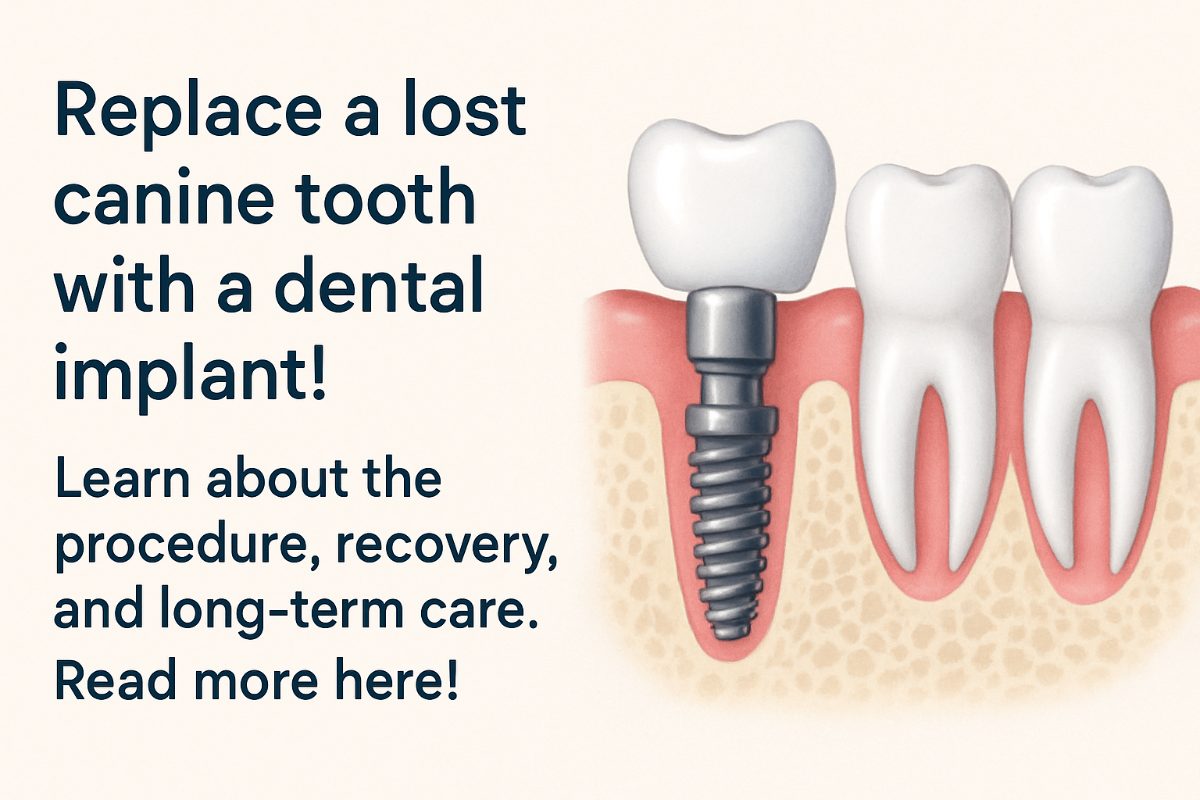
A dental implant canine tooth replaces a lost or damaged canine with a titanium implant and a custom crown. Canines play a key role in biting, guiding your jaw, and shaping your smile. This article explains why canine teeth matter, when a dental implant is recommended, how implants are planned and placed, and what to expect for recovery and long-term care.
Why The Canine Tooth Matters
Canine teeth help tear food and guide the bite during side-to-side movements — a concept called canine guidance. Losing a canine can change how your teeth meet, increase wear on neighboring teeth, and alter jaw comfort. Canines also support the lips and cheeks; a missing canine can affect smile symmetry and facial balance.
When A Dental Implant Canine Tooth Is Recommended
A dental implant is often recommended for a canine when the tooth is lost or can’t be saved. Common reasons include:
- Trauma or fracture that makes the tooth non-restorable
- Severe decay or a failed root canal
- Congenital absence of the tooth
- When a bridge would require altering healthy adjacent teeth
- When a removable denture won’t provide the needed function or esthetics
Evaluation & Planning For A Canine Implant
Clinical Exam And Digital Imaging
Planning starts with a clinical exam and digital imaging. Intraoral scans and CBCT (3D cone beam) images show bone volume, nerve locations, and root positions of nearby teeth. This information helps determine whether a dental implant in Flowood, MS can be placed immediately or if preparatory work is needed.
Treatment Options And Timing
Options include immediate implant placement at the time of extraction or delayed placement after healing. Immediate provisional crowns can help maintain esthetics in the smile zone, while delayed timing may be safer when infection or bone loss is present. Your dentist will weigh esthetic needs, bone health, and long-term function when recommending timing.
What To Expect During The Dental Implant Canine Tooth Procedure
Surgical Placement
Surgery usually uses local anesthesia and, if desired, nitrous oxide or IV sedation for comfort. Guided implant placement with a surgical guide improves accuracy. The implant is placed into the jawbone where the canine root used to be, then closed or fitted with a healing component.
Healing And Osseointegration
Over several weeks to months the bone fuses to the implant in a process called osseointegration. Follow-up visits monitor healing and tissue health. Many patients receive a temporary crown while the implant integrates, especially when a visible canine must be preserved for appearance.
Final Restoration
The final step is attaching an abutment and a custom crown shaped and colored to match surrounding teeth. A natural canine crown restores function, guides the bite, and completes the smile. Careful design ensures proper canine guidance and long-lasting performance.
Special Considerations For Canine Implants
Canine sites sometimes need extra work to support an implant:
- Bone grafting or ridge augmentation when bone is deficient
- Angled or narrow implants for unusual anatomy
- Digital planning to address esthetic challenges in the smile zone
Advanced techniques, including guided surgery and custom abutments, help manage these challenges and deliver predictable results.
Recovery, Care, And Longevity
Short-term care includes a soft diet, ice, gentle oral hygiene, and any prescribed pain control or antibiotics. Most patients return to normal activities within a few days. Long-term success depends on good home care and regular dental checkups. With proper maintenance, an implant-supported canine can last many years.
For many patients, financing and dental insurance options make a dental implant Flowood, MS treatment more accessible. Ask your provider about payment plans and preauthorization for coverage.
About Revive Denture & Implant Studio And Dr. Joseph Boone
Revive Denture & Implant Studio in Flowood, Mississippi offers digital planning, implant surgical guides, sedation options, and patient financing to support implant care. Dr. Joseph Boone has advanced implant training and years of implant experience. His clinical and teaching background supports precise implant placement and predictable restorations for canine and full-mouth cases.
If you’re missing a canine or facing a failing tooth, a dental implant in Flowood, MS may restore both function and smile aesthetics. Schedule a consultation to review your imaging, treatment options, and next steps with an implant team near you.